Does weed go bad?
Not like milk or bread. Dried, cured flower holds too little moisture for mould to grow, as long as it stays dry, so it does not rot on a shelf. Instead, it fades in three ways:
- The smell and flavour go first. Terpenes, the compounds behind the smell, dropped within four months at every temperature tested in a 2020 storage study from Israel's Technion.
- The THC slowly breaks down. Air and warmth slowly turn it into CBN, a much milder cannabinoid, and light breaks it down faster still. Our CBN guide covers that change.
- It dries out. Over-dry bud crumbles to dust and burns harsh.
So old weed is weaker and duller, not dangerous. The one exception is mould.
How much THC does weed lose over time?
The numbers most guides quote come from a University of Mississippi study by Ross and ElSohly, published in 1997. Flower kept in closed containers, in the dark, at 20 to 22°C, lost THC at a steady rate:
| Time stored | THC lost | A 25% THC bud would test about |
|---|---|---|
| 1 year | About 17% | 21% |
| 2 years | About 27% | 18% |
| 3 years | About 35% | 16% |
| 4 years | About 41% | 15% |
Those numbers come from flower kept closed and dark. A 2019 Italian study kept weed and hash at room temperature, some of it under constant light, and found almost all the THC gone after four years. How weed is kept matters more than how old it is.
Light does the most damage, then air. Warmth speeds both up. A bag on a sunny windowsill fades far faster than a sealed jar in a cupboard.
How long does weed last in storage?
No cannabis product has a hard expiry date, and no study gives one in months. These are the typical windows for each format when it is stored well, with the storage rule that matters most for each:
| Product | Best within | Store it |
|---|---|---|
| Flower and smalls | 6 to 12 months, then weaker but still smokable | Sealed bag or airtight jar, cool and dark |
| Pre-rolls | A few months | Box shut, cool and dark |
| THC gummies | Months, in the sealed pack | Pack resealed, cool dry cupboard |
| Carts and pens | 1 to 2 years | Upright, room temperature, out of the sun |
| Live rosin | A month or two | Sealed jar in the fridge |
| Hash | A year or more | Parchment, airtight, dark drawer |
| Distillate and RSO | 1 to 2 years | Syringe capped, cool and dark |
The easiest way to never smoke stale weed is to buy what you will finish in a few months. Our BC Bud is packed the day it ships, not bagged weeks ahead, so the clock starts when it reaches you.
Moldy weed vs trichomes: how to tell
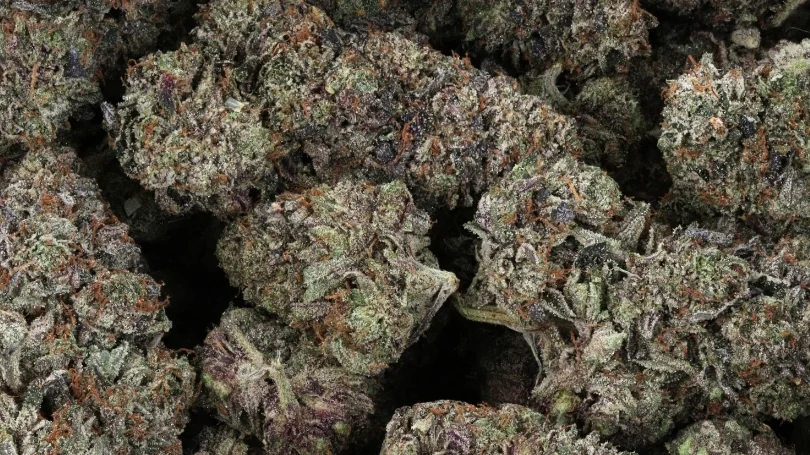
Old weed is easy to spot. It smells faint or like hay, crumbles when you squeeze it, looks browner than it did and burns harsh. Weed like that is fine to smoke, just weaker.
Mould is different, and it is the one reason to throw weed out. Look for:
- Fuzz or webbing. Mould sits on top of the bud as a dull, fuzzy or powdery coat. Trichomes are part of the bud: tiny glassy stalks with round heads that sparkle under light.
- Odd colours. Grey, white, blue-green or yellow patches. In a 2023 study of BC-grown buds, Simon Fraser University researchers saw one common mould show up bright yellow and another as whitish-blue fuzz.
- A musty smell. Damp, mildewy or like wet hay. Mould often reaches your nose before you see it.
- A damp or spongy feel. Bud that feels damp or squishy is holding too much water, and wet bud is where mould grows.
- The middle of the bud. Dense buds can rot from the inside, so break a big one open.
If you find any of it, throw that bud out. Cutting off the bad part does not work, because mould spreads further than you can see. Set the rest of the stash apart and check it too.
Best way to store weed and keep it fresh
- Airtight. Air slowly oxidizes THC. A glass jar with a good seal is the usual pick for keeping weed for months. A resealable bag works too if you press the air out every time you close it.
- Dark. Light does the most damage, so use a cupboard or drawer, not a windowsill or a clear jar on the counter.
- Cool. Below about 25°C, away from the stove, heaters, sunny windows and the car.
- Not too dry, not damp. Flower keeps best at about 55 to 65% humidity, the range set in the ASTM standard for dried cannabis. Drier and it crumbles; wetter and mould can grow. A two-way humidity pack made for flower holds a jar in that range.
- Whole, not ground. Grinding breaks open the resin glands that protect THC and smell, and ground flower breaks down faster than whole buds. That is also why pre-rolls fade sooner. Keep buds whole until you roll, then grind just what you need in an aluminum grinder.
Concentrates follow the same rules with one twist: live rosin and live resin keep best in the fridge. Our live resin vs live rosin vs distillate guide covers each one, and our hash guide covers storing hash.
Do edibles and THC gummies expire?
Gummies do go off eventually, but slowly, and a sealed pack protects the THC well. In a study of THC oil capsules kept in sealed foil packs, more than 97% of the THC was still there after three months, even at room temperature.
Heat and damp ruin a gummy faster than time does. A hot car melts a bag into one block, and a pack left open picks up moisture and can grow mould. Kept sealed in a cool, dry cupboard, THC gummies hold their dose and texture for months. If a pack has a date printed on it, go by that. There is no need to freeze them. Keep the pack apart from regular snacks and out of reach of kids and pets, since gummies look like ordinary candy.
Do carts and weed pens expire?
The oil in a cart does not spoil, but it fades. A classic 1976 storage study found well-made cannabis extracts stayed fairly stable for one to two years kept dark at room temperature, then slowly lost flavour and strength.
Two signs a cart has faded: the oil is far darker than when it was new, and each hit tastes flat or harsh. Store carts and pens upright at room temperature, away from sun and heat. A hot car is the worst place for one. Skip the fridge, since cold thickens the oil and can clog it. If a cart will sit unused for a while, unscrew it from the battery. Our weed pen guide covers the rest.
Sources
- Milay L, Berman P, Shapira A, Guberman O, Meiri D. Metabolic profiling of cannabis secondary metabolites for evaluation of optimal postharvest storage conditions. Frontiers in Plant Science, 2020. Read the study
- Ross SA, ElSohly MA. CBN and delta9-THC concentration ratio as an indicator of the age of stored marijuana samples. Bulletin on Narcotics, 1997. Read the study
- Zamengo L, Bettin C, Badocco D, et al. The role of time and storage conditions on the composition of hashish and marijuana samples: a four-year study. Forensic Science International, 2019.
- Fairbairn JW, Liebmann JA, Rowan MG. The stability of cannabis and its preparations on storage. Journal of Pharmacy and Pharmacology, 1976.
- Punja ZK, Ni L, Lung S, Buirs L. Total yeast and mold levels in high THC-containing cannabis (Cannabis sativa L.) inflorescences are influenced by genotype, environment, and pre- and post-harvest handling practices. Frontiers in Microbiology, 2023. Read the study
- Gwinn KD, Leung MCK, Stephens AB, Punja ZK. Fungal and mycotoxin contaminants in cannabis and hemp flowers: implications for consumer health and directions for further research. Frontiers in Microbiology, 2023. Read the study
- Utah State University Extension. Bud rot (hemp). Plant health fact sheet. Read the fact sheet
- ASTM International. D8197-22, Standard specification for maintaining acceptable water activity (aw) range (0.55 to 0.65) for dry cannabis flower intended for human/animal use. 2022.
- Wempe MF, Oldland A, Stolpman N, Kiser TH. Stability of dronabinol capsules when stored frozen, refrigerated, or at room temperature. American Journal of Health-System Pharmacy, 2016.